
Reverse Osmosis Undersink Water Filter System
Enjoy pure, great tasting drinking water straight from your tap. Armour Reverse Osmosis systems remove dissolved salts, heavy metals, and hidden impurities, giving your family cleaner, safer water with every glass.
Reverse Osmosis Water Filters for Pure Drinking Water
If you want the highest quality drinking water from your kitchen tap, a reverse osmosis water filter is considered the gold standard. Using advanced membrane filtration technology, reverse osmosis systems remove up to 99% * of dissolved contaminants, including heavy metals, chlorine, fluoride, nitrates, and PFAS chemicals. The result is clean, great-tasting water delivered directly from a dedicated tap at your kitchen sink.
At Armour Water, we supply and install premium under-sink reverse osmosis water filtration systems designed specifically for Australian homes and water conditions. Our compact systems fit neatly inside your kitchen cabinet while providing powerful multi-stage filtration that significantly improves the taste, purity, and safety of your drinking water.
Whether your home uses mains water or a rural supply, our team helps you choose the right reverse osmosis water filter system for your needs. We provide professional installation and ongoing maintenance to ensure long-term performance and reliable filtration.
Clean, purified drinking water should be simple, accessible, and reliable for every Australian household.
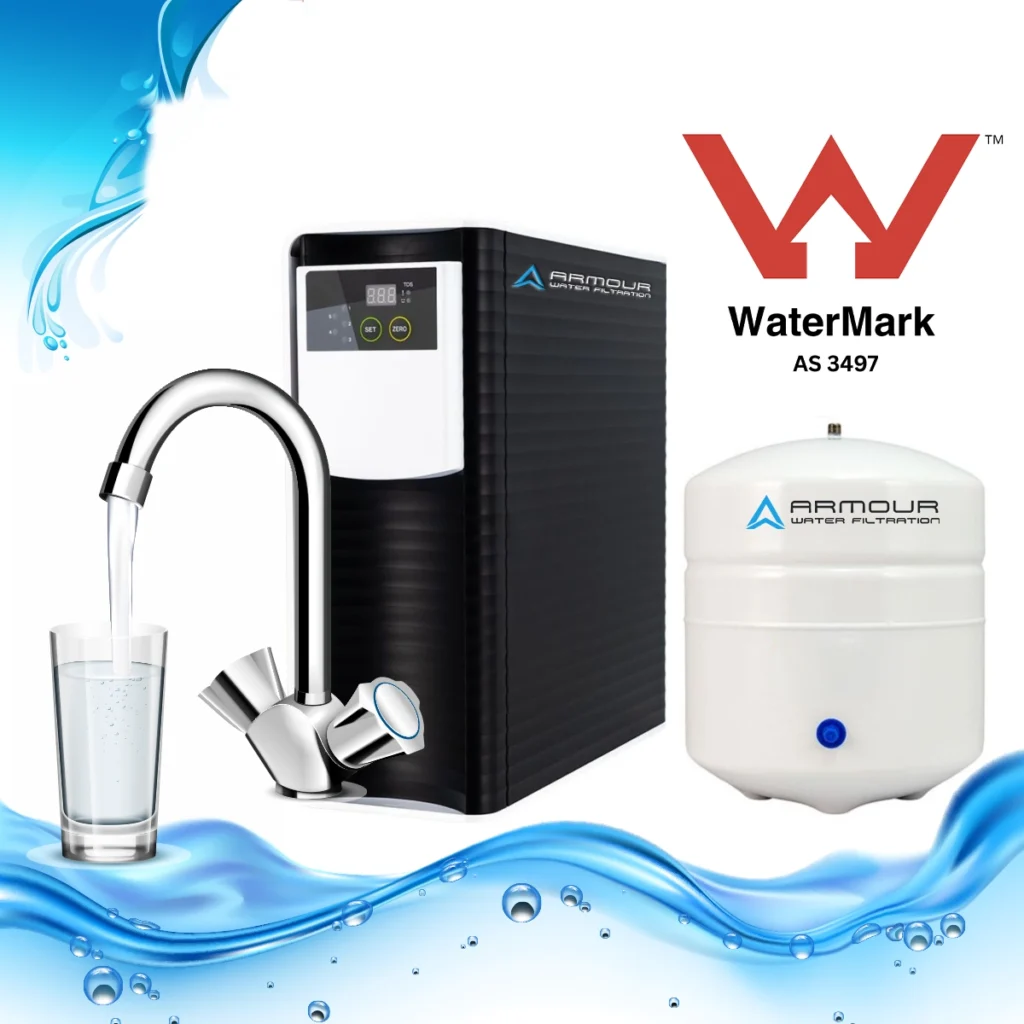

How a Reverse Osmosis Water Filter System Actually Works
Understanding how osmosis water filters work helps you appreciate just how effective this technology really is. At the heart of every osmosis water filter system is the RO membrane. This is a tightly structured semi-permeable barrier with pores as small as 0.0001 microns. To put that in perspective, most bacteria are around 1 micron in size and water molecules themselves pass through at just 0.0003 microns. The RO membrane is so precise that it physically blocks dissolved salts, heavy metals, fluoride, nitrates, and a vast range of other contaminants while allowing clean water molecules to pass through to your tap.
Your incoming water supply is pressurised through a series of pre-filtration stages before it ever reaches the RO membrane. These stages remove sediment, chlorine, and organic compounds that could otherwise damage the membrane and reduce its lifespan. After passing through the membrane, the filtered water passes through a final polishing carbon stage before reaching your dedicated mixer tap, ensuring it tastes as clean and fresh as it is.
This multi-stage process is what makes a sink water filtration system based on reverse osmosis so much more effective than a basic carbon filter or a pitcher-style unit. Every stage has a specific job to do, and together they deliver water filtration that no single filter technology can match on its own.
The Multi-Stage Filtration Process Explained
Our Smart RO undersink system uses a proven five-stage filtration approach. Here is how each stage works and why it matters.
Stage One: Pre-Sediment Filtration
The first stage uses a 1 micron sediment filter composed of 100% melt-blown polypropylene fibre. It captures sand, dirt, silt, rust, plant spores, and suspended solids before water flows deeper into the system. This step is critical, as it protects the carbon pre-filters and the RO membrane from physical damage caused by particulate matter. Without regular replacement every 6 months, reduced flow, lower osmotic pressure, and diminished filtration efficiency will follow.
Stage Two: Granular Activated Carbon (GAC) Pre-Filtration
The second stage uses a high-grade granular activated carbon (GAC) pre-filter. GAC removes chlorine, chloramines, and absorbed organic chemicals from the water supply before it reaches the RO membrane. This is essential because chlorine directly damages the membrane over time and reduces its lifespan. This stage protects the membrane while improving overall water taste and extending the service life of the entire system. Replace every 6 months.
Stage Three: Coconut Carbon Block Pre-Filtration
The third stage uses a dense coconut carbon block filter to provide maximum contact time and contaminant removal immediately before the RO membrane. This stage handles the heaviest remaining chemical reduction load, targeting chloramines, VOCs, and fine organic compounds that GAC alone may not fully capture. This final pre-filtration stage ensures the membrane operates under the cleanest possible conditions, maximising both its performance and its lifespan. Replace every 12 months.
Stage Four: The Reverse Osmosis Membrane
The RO membrane is the engine room of the system. Water is forced under pressure through an ultra-fine, semi-permeable membrane rated at 0.0001 micron, blocking dissolved salts, heavy metals, fluoride, nitrates, PFAS, and virtually all fine dissolved contaminants. This stage produces up to 190 litres of purified water per day and separates clean water from concentrated waste. The Smart Monitor continuously measures TDS output so you always know when the membrane needs replacing — typically every 2 to 3 years depending on your water hardness.
Stage Five: Alkaline Coconut Carbon Post-Filter
The final stage uses the finest grade of Japanese-grade activated coconut carbon to ensure a pure, clean taste and remove any residual odour from the stored water. The water then passes through calcite (CaCO₃) alkalising media, which raises and buffers the final pH to between 7 and 8 — delivering naturally alkaline drinking water without adding hardness. This stage is standard on all systems. Replace every 12 months.
Smart RO Technical Specifications
| Specification | Details |
|---|---|
| System Type | 5-Stage Undersink Reverse Osmosis |
| Certification | WaterMark Certified — AS/NZS 3497 |
| Membrane | 50GPD Filmtec RO Membrane |
| Booster Pump | Compact booster — up to 620 kPa working pressure |
| Contaminant Rejection | Up to 99% (under optimal pressure conditions) |
| Filtration Rating | Down to 0.0001 of a micron |
| Output pH | 7–8 (Alkaline to pH neutral) |
| Production Rate | Approx. 8 litres per hour |
| Smart Monitor | Real-time TDS reading, filter reminders, leak detection |
| Filter Change — Stages 1 & 2 | Every 6 months |
| Filter Change — Stages 3 & 5 | Every 12 months |
| Membrane Change | 2–4 years (based on Smart Monitor TDS reading) |
*Performance figures are indicative. Results vary by contaminant type, incoming water quality, pressure, and system configuration.
WaterMark Certification
The Armour Undersink RO System is WaterMark Certified to AS/NZS 3497, meeting Australian standards for safe and reliable professional installation of water filtration systems.
Do not trust systems without WaterMark certification. Non-certified products may be hazardous to your health and can result in denied insurance claims under Australia’s plumbing and drainage laws.
Warranty and Support
- 2-year hardware warranty. Labour included for the first 12 months. Parts and hardware covered for the full 2-year period.
- Automatic email reminders when filters are due — never forget a change again
- DIY filter changes are simple — or we can do it for you
- Ongoing phone and email support
- Local installer follow-ups available if needed
30-Day Satisfaction Guarantee
If you are not completely satisfied within 30 days, contact us, and we will make it right.
Get Cleaner Safer Water For Your Home
Our Armour Undersink RO System averages around $1,600 fully installed professionally. Final pricing is confirmed at your consultation and may vary depending on your property and whether installed alongside our Whole Home system.’ Also add: ‘Finance available through Zip.
Book your water consultation today and discover the best water filtration solution for your home. Our experts identify water issues and recommend the right system for clean safe great tasting water.
What Contaminants Do Our Reverse Osmosis Water Filters Remove?
Reverse osmosis water filters provide one of the most comprehensive filtration solutions available for residential drinking water. By combining multiple pre-filtration stages with a high-performance RO membrane, these systems remove a wide range of contaminants commonly found in Australian water supplies.
This advanced filtration process significantly reduces heavy metals, chemicals, dissolved solids, and other unwanted impurities that can affect the safety, taste, and quality of drinking water. The result is cleaner, purer water delivered directly from your kitchen tap.
Our reverse osmosis systems are designed to provide reliable filtration performance for both mains water and rural water supplies, helping households gain greater control over the quality of their drinking water.
Heavy Metals
Removes lead, arsenic, mercury, chromium, cadmium, and barium that may be present in ageing plumbing or groundwater supplies.
Fluoride Reduction
Reverse osmosis is one of the few filtration technologies capable of effectively reducing fluoride in drinking water.
PFAS & Industrial Chemicals
Helps reduce PFAS chemicals, nitrates, nitrites, pharmaceutical residues, and other chemical contaminants.
Microplastics & Pathogens
Ultra-fine membrane filtration removes microplastics, bacteria, and many other microscopic impurities from drinking water.
Under-Sink Installation: Compact, Discreet, and Easy to Install
One of the biggest advantages of our under sink water filter Australia systems is how neatly and efficiently they install in your kitchen. Everything fits inside the cabinet beneath your sink, keeping your bench space completely clear and uncluttered. A dedicated mixer tap is mounted through a small hole in the benchtop or sink, giving you instant access to purified drinking water without taking up valuable counter space.
Our undersink water systems are designed for straightforward installation by experienced technicians, with all connections, fittings, and mounting brackets included. Installation usually takes around two to three hours, and once complete your reverse osmosis system Australia is ready to deliver filtered water immediately. There is no complicated calibration, no special tools required after installation, and no ongoing adjustments needed to maintain reliable filtration performance.
Before leaving, our technicians explain how to operate and maintain your sink water filter so you feel confident using it every day. We also supply models suitable for confident DIY homeowners who prefer installing their own under sink water filter system. These undersink water systems include detailed instructions and all required components, although professional installation is always recommended to ensure peak filtration performance and maintain full warranty coverage.
Choosing the Right Under Sink Water Filter System for Your Home
Choosing the right under sink water filter Australia system begins with understanding your home’s water quality and your household’s daily drinking water needs. Not all water filter systems perform the same, which is why our range of reverse osmosis systems in Australia includes everything from entry-level multi-stage setups through to systems with alkaline enhancement.
For most Australian homes connected to mains supply, a quality four or five-stage reverse osmosis water filter system provides excellent filtration performance straight out of the box. If your property relies on well water, rainwater tanks, or water testing shows elevated heavy metals or biological contaminants, we may recommend a more advanced configuration — our team will advise at consultation.
Flow rate is another key factor when selecting the right under sink water filter system. Larger households require a system capable of producing enough filtered water to meet daily cooking and drinking needs without frequently emptying the storage tank. Our team carefully sizes each reverse osmosis system Australia installation to match your household usage so you always have clean water available.
Budget is also important. Our range of under sink water filters includes options across multiple price points, and we clearly explain ongoing filter system maintenance costs so you can make a confident, fully informed decision.
Maintenance, Filter Cartridge Replacement, and Long-Term Performance
Keeping your water filtration system performing at its best is straightforward with the right routine. Our undersink water systems are designed with easy to install, twist-lock or quick-change filter cartridge housings that make servicing quick and simple. No special tools, no mess, and no need to call a technician every time a cartridge needs to be changed.
Pre-filter stages require replacement on a fixed schedule to protect the RO membrane. The Stage 1 sediment filter and Stage 2 GAC pre-filter must be replaced every 6 months — this is critical, as failing to do so reduces flow, lowers osmotic pressure, and shortens membrane life. The Stage 3 carbon block pre-filter and Stage 5 alkaline post-filter are replaced every 12 months. The RO membrane typically lasts 2–4 years, depending on your local water hardness and usage — on hard water, plan for replacement at the 2-year mark. The Smart Monitor’s real-time TDS display tells you exactly when performance is dropping, so you never have to guess.
Our water systems are built to last. With regular maintenance, a quality sink water filtration system will deliver outstanding water filtration performance for many years. We stock all replacement parts and cartridges for every system we sell, so you are never left waiting when service time comes around.
Why Armour Water Is the Trusted Name in Reverse Osmosis Water Filters
difference to people’s lives. Our water filter systems are independently certified to NSF and ANSI standards, meaning you can trust the performance claims we make. We do not just sell products. We build long-term relationships with our customers, supporting them through installation, ongoing maintenance, and any questions that come up along the way.
Our team has deep experience with water systems across all types of Australian properties and water conditions. We have helped thousands of families make the switch to better drinking water, and we love hearing from customers who tell us their water has never tasted better. When your water filtration system is working the way, it should, the difference is something you notice every single day.
If you are ready to experience the difference that a properly installed, high-performance reverse osmosis water filter can make in your home, we are ready to help. Get in touch today for a consultation. Our friendly team will answer your questions, help you select the right water filters for your needs, and organise a fast, professional installation. Because great-tasting, genuinely clean water should be easy to install, easy to maintain, and available to every Australian family.
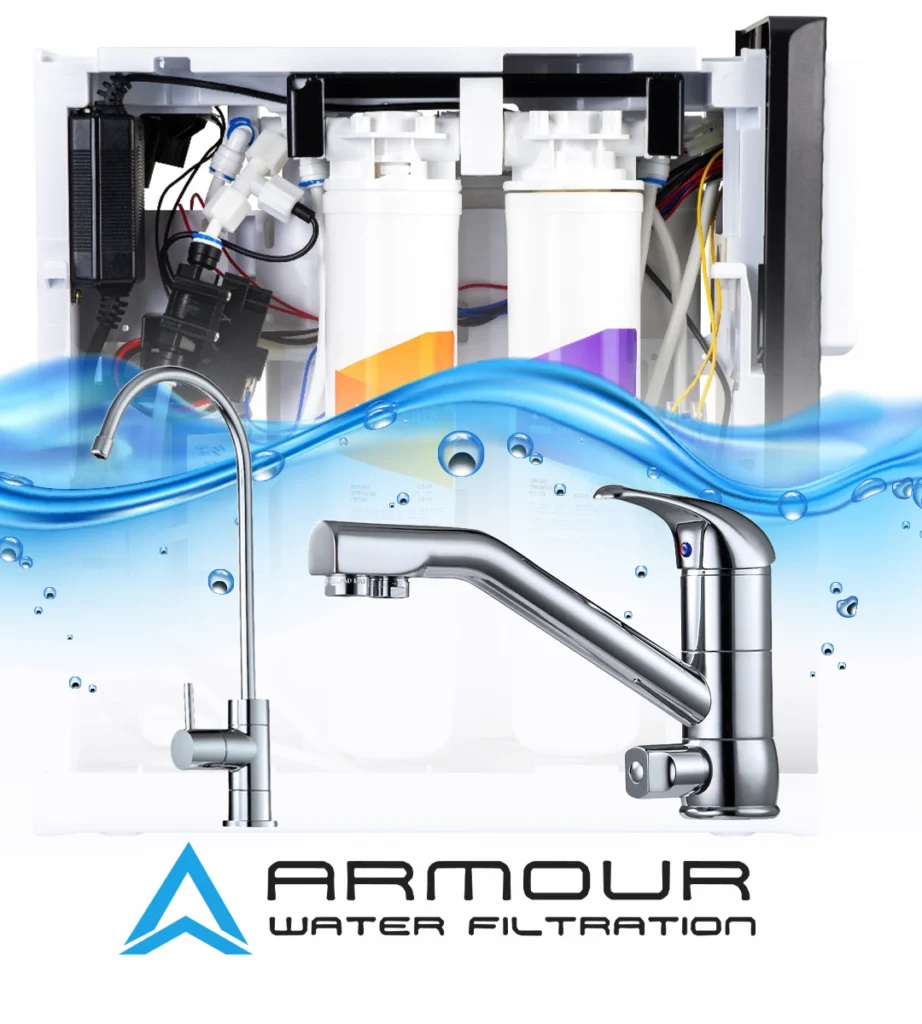

Professional service, clear advice, and a filtration system that delivers consistent results. A smart upgrade for any household concerned about water quality.
Frequently Asked Questions About Reverse Osmosis Water Filters
Yes, our under-sink osmosis water filter system range is specifically designed to be easy to install in standard Australian kitchens. The entire system sits neatly inside the cabinet beneath your sink, so there is no impact on bench space or kitchen aesthetics. A dedicated mixer tap is mounted through a pre-existing hole in your sink or through a small hole drilled in the benchtop, giving you a clean, purpose-built outlet for your filtered water.
Professional installation by our qualified technicians typically takes two to three hours from start to finish. All connections are made to your existing cold water supply line, and a small drain connection is made for the RO membrane waste-water outlet. Our technicians are easy to install experts who handle the entire process efficiently and cleanly, leaving your kitchen neat and your new sink water filter ready to produce high quality, filtered water immediately. We also provide confident DIY homeowners with models that are designed to be easy to install at home, complete with detailed instructions and all required fittings included in the box.
The RO membrane is the most important component in your water filtration system and the most durable. Under normal usage conditions and with properly maintained pre-filtration stages, a quality RO membrane will typically last two to five years before it needs replacement. The key to maximising membrane life is ensuring your pre-filters are changed on schedule. If chlorine or sediment is allowed to reach the membrane in high concentrations because a pre-filter has not been replaced, the membrane can degrade significantly faster.
We monitor membrane performance through your regular service intervals and can test the total dissolved solids (TDS) level of your filtered water to confirm your RO membrane is still performing correctly. A significant rise in TDS output is a reliable indicator that the membrane is due for replacement. We stock replacement membranes for every osmosis water filter system we sell and can schedule a replacement service at a time that suits you. With regular care, your entire filter system will deliver reliable, high-quality water filtration for many years.
Yes, this is one of the standout advantages of a reverse osmosis water filter over other water filters. Fluoride is a dissolved ionic compound, and its water molecules are too large to pass through the ultra-fine pores of the RO membrane. As a result, reverse osmosis consistently removes between 90 and 96 per cent of fluoride from your drinking water, which is far higher than any activated carbon or ceramic water filter can achieve.
For families who prefer not to consume fluoridated water, or who have specific health or medical reasons for avoiding fluoride, a sink water filtration system using reverse osmosis technology is the most reliable solution available for residential use. It is important to note that fluoride is added to municipal water supplies across most Australian cities, so if fluoride removal is a priority for your household, standard carbon-block water filter systems will not meet your needs. Our osmosis water filters are independently tested and certified to confirm fluoride removal performance, giving you full confidence in the quality of your water filtration results.
Traditional osmosis water filter systems include a pressurised holding tank that stores filtered water, so it is ready on demand at your mixer tap. These are the most common type of undersink water systems and work well for most households. The tank stores enough water to meet typical demand throughout the day, and the system refills the tank gradually between uses.
Tankless water systems are a more recent innovation that filter water on demand without needing a storage tank. They are more space efficient, produce water with lower wait times in some configurations, and eliminate the small risk of bacterial growth that can occur in tank-based water filter systems if they are not maintained properly. However, tankless systems typically require higher incoming water pressure to function correctly and may have a lower instantaneous flow rate than a tank-based system.
Both types use the same core RO membrane technology and deliver the same high standard of water filtration. Our team will discuss both options with you and recommend the configuration that best suits your under-sink space, household water usage habits, and incoming water supply pressure. The goal is always to ensure your osmosis water filters deliver reliable, high-quality filtered water with minimal fuss.
An osmosis water filter system is a point of use filter system that treats water at a single outlet, typically the kitchen sink. It delivers the highest level of water filtration available for residential use, removing a far broader range of contaminants than most whole house systems can match. If drinking water purity is your primary concern, a sink water filtration system based on reverse osmosis is hard to beat.
A whole house system, by contrast, treats all water entering the property at the point of entry. It improves water supply quality across every outlet including showers, laundry, and appliances, but it typically does not achieve the same level of contaminant removal as a dedicated RO membrane system. Many of our customers choose to combine both approaches: a whole house system to protect plumbing and improve overall water quality, paired with an undersink RO unit at the kitchen sink for premium, pure drinking and cooking water. This combination represents the most comprehensive water filtration solution available for Australian homes, and our team can design a solution that meets all your needs.